

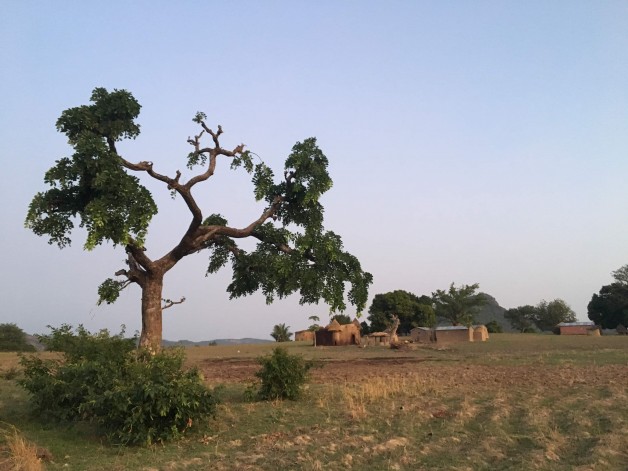
Je suis dans mon avion vers le Togo et à part quelques informations , je me suis rendu compte il y a quelques semaines que je ne connaissais pas grand chose de ce pays. C’était pour moi, un voyage en terre inconnue.
Je savais que c’était une ancienne colonie allemande située en Afrique de l’Ouest. La langue officielle est le français et la capitale est Lomé.
C’était les seules informations, assez superficielles que j’avais avant de préparer mon voyage.
Je n’aime pas planifier mes voyage au jour le jour. Mais je n’aime pas partir sans un minimum de connaissance. C’est le meilleur moyen de faire un faux pas culturel, de se faire arnaquer, de se sentir perdu et de gâcher son voyage.
Internet et les réseaux sociaux te permettent un accès facile à l’information. Ça serait stupide de ne pas en profiter.
Comment m’est venu l’idée de partir en terre inconnue ?
J’avais depuis longtemps, l’envie de découvrir l’Afrique subsaharienne à moto. Après avoir voyagé avec mes propres moyens de locomotion au Vietnam et au Sri Lanka, je voulais absolument vivre la même expérience en Afrique. C’est le meilleur moyen de vivre au plus près des locaux.
Comme ce continent est moins touristique, j’ai eu du mal à trouver des informations fiables qui me permettent de m’orienter vers un pays en particulier.
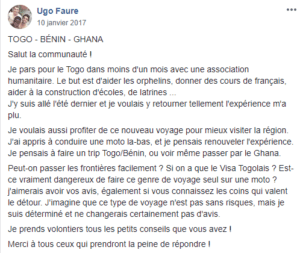
J’ai trouvé un post facebook, dans le groupe « voyages sac à dos backpackers« :
Il y a plus d’un an, Ugo cherchait des informations pour préparer son voyager à moto au Togo. J’ai répondu à son message.Je lui ai demandé s’il avait pu faire son trip et s’il pouvait me donner des conseils. Il ne s’attendait pas à voir ce post ressortir. Bonne nouvelle, il avait pu faire son trip en restant au Togo.
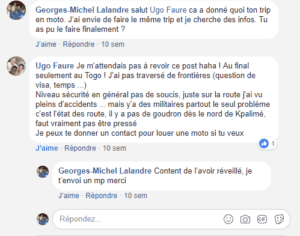
Nous avons ensuite échangé par messages privés. Il m’a expliqué qu’il faisait très chaud, qu’il buvait 10 litres d’eau par jour « sans pisser », que la circulation n’était pas très bonne et que les policiers étaient équipés de mitraillettes.
Il m’a aussi proposé de me mettre en relation avec la personne à qui il avait loué la moto. Bref, il m’a décidé à aller au Togo.
Comment j’ai organisé mon séjour au Togo ?
Lorsque je prépare un voyage avec mon propre moyen de locomotion, je ne cherche pas une pluie d’informations. Le voyage, la moto, c’est la liberté. Je n’ai pas besoin de planifier un itinéraire, ni de connaitre à l’avance les choses à voir.
Ce qui m’intéresse c’est d’avancer librement, au gré des rencontres, en ayant un minimum de connaissances des codes du pays, pour le faire sans trop de danger.
J’ai simplement besoin d’avoir des réponses aux questions suivantes:
- Faut-il un visa ? Des vaccins ?
- Est-il légal pour un étranger de conduire une moto ?
- Puis je facilement acheter une moto et est il facile de la revendre ?
- Sinon puis je facilement louer une moto ?
- Trouve-t-on aisément de l’essence ?
- Trouve-t-on facilement de l’eau ?
- Est ce que la police est corrompue ? Si oui, combien demande t elle pour te laisser tranquille ?
Le reste, le parcours, le logement… j’ai suffisamment voyagé pour savoir que je suis capable de l’improviser sur place en fonction des rencontres.
Les visas, les vaccins, la réponse est facile à trouver sur le site des conseils aux voyageurs du 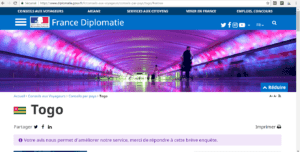 ministères des affaires étrangères.
Pour les autres réponses, la seule source d’information ce sont les blogueurs ou les voyageurs et les locaux sur place. Ugo, a pu répondre à mes différentes questions. Je sais donc que c’est légal avec le permis international de conduire une moto.
Acheter une moto est possible, mais c’est coûteux ( 300 € d’occasion). Le pays est très peu touristique, donc la revente en 1 h à un autre voyageur comme au Vietnam est impossible. Il a un contact qui peut me louer une bonne moto à un bon prix.
Ugo m’a assuré qu’on trouvait partout de l’eau et de l’essence. Il m’a dit que la vie n’était pas cher. Il avait vécu un mois avec 400 €. Enfin, la police est honnête.
Cette dernière question peut te paraître stupide mais lors de mon voyage au Kirghizistan, j’ai fait une partie de mon parcours en voiture. Nos contacts sur place nous avaient informé que la police chercherait à nous soutirer de l’argent, sans raison, mais que nous nous en sortirions en leur laissant l’équivalent de 50 centimes.
Nous nous en sommes toujours sorti pour moins de 1€, mais le marchandage commençait parfois à 50€… C’est toujours rassurant de connaitre ta marge de manœuvre face à des forces de l’ordre corrompues, dans un pays inconnu.
Ugo m’a également expliqué qu’il n’avait pas circulé en dehors du sud du Togo avec sa moto, car il était parti dans le cadre d’un voyage humanitaire, avec son association Yananga.
Suite à sa proposition, j’ai pu assister à une réunion de l’association avant mon départ.
N’ayant aucune connaissance dans ce domaine, ce fut une rencontre très intéressante qui m’a permis d’en apprendre un peu plus sur le Togo et de découvrir ce milieu associatif que je ne n’avais jamais réellement fréquenté. (Si tu souhaites t’engager dans l’humanitaire, n’hésite pas à les contacter, ils sont toujours à la recherche de bonne volonté.)
Comment mon voyage m’a permis de faire des rencontres avant mon départ ?
Comme je te l’expliquais, ce qui m’intéresse le plus dans le voyage ce sont rencontres. En préparant mon départ au Togo, je me suis rendu compte que le voyage et les rencontres commencent déjà lors de la préparation.
Après avoir fait la connaissance d’Ugo et assisté à la réunion de son association, je me suis consacré à la préparation du reste de mon aventure.
Pour ce trip, j’avais aussi pour idée de partir avec une tente, et de camper dans les villages. J’imaginais que c’était facile à faire puisque les gens parlent français. Ce qui, je te le concède est un raisonnement hyper basique et qui ne présente pas une grande fiabilité.
Du coup comment faire pour savoir si c’était vraiment possible ?
J’ai d’abord commencé par demander à mes amis et ma famille. Ugo avait visité le pays avec son association. Il n’avait donc pas réellement idée de la possibilité de se débrouiller par ses propres moyens au Togo.
Loïc, un pote de longue date qui a pas mal baroudé, qui avait voyagé au Ghana à moto par ses propres moyens et a vécu et voyagé dans plusieurs pays d’Afrique (c’est à ce moment là que je me suis demandé pourquoi je ne lui avais pas demandé des informations plus tôt, et à ce jour je n’ai pas de réponse à cette question) m’a rassuré en me disant que les Africains étaient les gens les plus sympas et les plus accueillants qu’il ait croisés au cours de ses voyages.
C’était rassurant mais ça ne répondait pas vraiment à ma question. Entre temps, les personnes avec qui Ugo m’avait mis en relation m’ont proposé de me recevoir à l’aéroport et me loger à Lomé.
Ce qui venait confirmer les dires de Loïc. En m’étant informé un minimum sur le pays et grâce aux rencontres qui en ont découlé, j’ai désormais des personnes pour m’accueillir et m’aider à faire mes premiers pas dans ce pays inconnu. Rien ne vaut un hôte local pour bien démarrer ton voyage.
Ensuite j’ai acheté le petit futé Togo. C’est le seul guide de voyage exclusivement consacré à ce pays. Je n’y ai pas trouvé ce genre d’informations mais c’est toujours intéressant d’avoir ce type d’ouvrage.
Même si je les utilise rarement pour organiser mes voyages, je trouve que les guides permettent d’avoir une vision globale du pays et de ses traditions. C’est indispensable avant une arrivée en terre inconnue.
Les guides sont intéressants mais pour des renseignements plus précis, je trouve que les meilleures informations se trouvent sur les blogs.
Ils présentent l’avantage de pouvoir être facilement mis à jour, on peut poser des questions aux blogueurs et on trouve souvent pleins d’informations complémentaires dans les commentaires. J’ai cherché, encore cherché et je n’ai rien trouvé. J’étais un peu déçu, mais je me suis dit que mon article sur le Togo, à mon retour, allait combler ce vide.
Finalement j’ai fait appel à une communauté plus large. Comme Facebook m’avait permis de rencontrer Ugo et d’avancer pas mal dans mon voyage j’y suis retourné et j’ai aussi parcouru le forum.
C’est sur Voyage Forum que j’ai trouvé la réponse à ma question, dans une discussion sur Moto et Itinéraire Bénin Togo. J’ai laissé un message et Thibaut qui avait participé à la discussion m’a recontacté par mail. On a échangé par message puis par téléphone.
Thibaut est un passionné de l’Afrique, il partage sa vie entre la France et le Bénin où il développe des activités de tourisme solidaire. Il a plusieurs fois voyagé à moto au Togo et au Bénin et m’a expliqué qu’il facile de camper dans des villages. Il suffit de s’adresser au chef du village, de lui demander l’hospitalité et de lui laisser un présent en partant. Ça tient en une phrase mais c’est incroyablement utile. Maintenant je sais que c’est faisable et je sais comment faire.
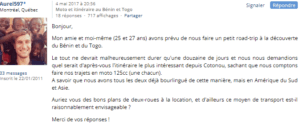
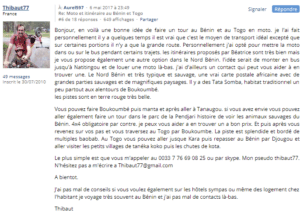
J’avais toutes les réponses à mes questions mais la préparation de mon voyage et les rencontres n’étaient pas finies.
3 jours avant mon départ, j’ai rencontré un pote par hasard. On discute, je lui parle de mon voyage qui approche. Il me dit de rester avec lui. Un ami Togolais à lui arrive et du coup il va en profiter pour me le présenter.
Son pote est cool et que ça va lui faire plaisir de me donner des informations sur son pays. Carmel arrive, et est effectivement super sympa, on discute pas mal, il me laisse son numéro et me dit qu’en cas de besoin il a pleins de contacts sur place. Il me donne un conseil, sur sujet auquel je n’avais pas pensé: le change.
Il me conseille de prendre des billets de 100 € et de les changer dans la rue. Le taux est meilleur qu’au distributeur. Enfin, il me donne 50 000 CFA qui lui reste de son dernier voyage, pour que je sois tranquille lors de mon arrivé et me dit que je n’aurais qu’à lui rendre à mon retour. Mon pote avait raison, Carmel est hyper cool.
Enfin, dans l’avion, où je suis actuellement, je me trouve à coté d’un quinquagénaire européen très sympathique. On a pas mal discuté, je lui ai parlé de mon projet de voyage à moto. Denis m’a expliqué qu’il vit depuis 30 ans en Afrique, il y a monté plusieurs sociétés, mais c’est avant tout un passionné de moto qui a fait 4 fois le Paris Dakar.
Du coup, il vient de me proposer de passer chez lui demain pour me donner des cartes avec toutes les plus belles pistes du Togo.
Comme tu le vois, préparer un minimum mon voyage, m’a permis de rencontrer de nouvelles personnes très intéressantes, qui en plus m’ont donné une bonne image du Togo. Un pays sûr, avec des habitants accueillants et un coût de la vie abordable. « Tu verras les Togolais sont incroyablement gentils »: c’est la phrase que j’ai le plus entendue.
Je vais bientôt atterrir dans ce pays peu touristique dont je ne connais quasiment rien mais je suis super content. On ne sait pas vraiment à quoi ressemble un endroit avant d’y aller. Mais je sais à peu près à quoi m’attendre. J’ai des hôtes locaux qui vont m’accueillir. Je connais les principaux codes qui vont me permettre d’évoluer sereinement durant mon voyage.
Voyager dans un pays que tu ne connais pas, sortir de ta zone de confort, peut faire peur. Mais, faire un minimum de recherches et échanger avec d’autres personnes efface cette peur. Il n’est pas question de faire un programme au jour le jour, mais simplement de t’informer sur ta destination: un voyageur préparé et informé est un meilleur voyageur.
J’ai encore tout à apprendre sur le Togo. Mais maintenant je peux le faire avec ce que m’ont transmis mes nouveaux amis et ceux qui m’attendent à l’aéroport de Lomé.
Mon avion vient d’atterrir, je te laisse. Mon aventure continue. Je suis pressé de rencontrer mes amis togolais et de poser le pied dans ce pays dont je ne connais rien.
Et toi es tu déjà parti dans un pays dont tu ne connaissais rien ? Comment prépares tu tes voyages ?