

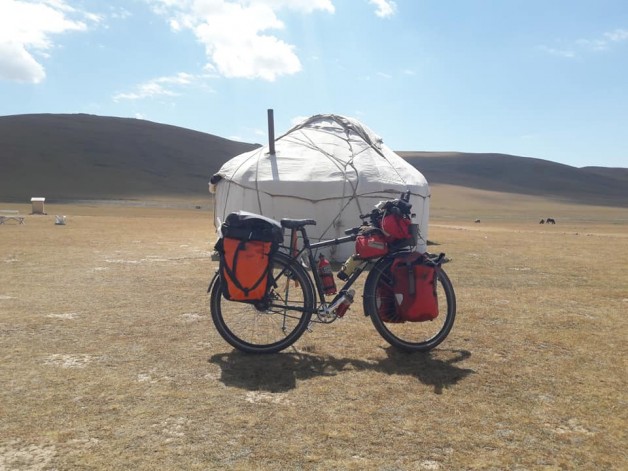
..
Since creating theKyrgyzstan travel group, I have met and talked with quite a few different people. Marie is one of them. Not only did she travel to a country that I particularly love, she did so by bike.
Those who know me know that I am passionate about cycling. A bike race brings together all the emotions of life: pain, happiness, suspense, disappointment, surprises, and joy. I have immense admiration for bicycle travelers.
It was only natural that I followed Marie's trip with great interest. When she returned, I asked her to write an article about her cycling trip to Kyrgyzstan. She did me the honor of accepting, and we had fun doing this Q&A (an interview, basically).
Hi Marie, thank you for agreeing to share your cycling experience in Kyrgyzstan. First of all, can you introduce yourself?
Marie, 52 years old, ex-triathlete (a shoulder injury-falling off my bikenow prevents me from swimming) musician. I love cycling (I ride all year round by road and mountain bike, and also I ride a bike to work) I love to travel, and I love cycling. I usually go 4 times a year, I make the most of the holidays (except for Christmas) to ride my bike. In the summer, I ususally leave for generally between 7 and 8 weeks straight. 3,200 km last year in Iceland, 2,700 km this summer between Dushanbe and Bishkek.
Why do you travel by bike?
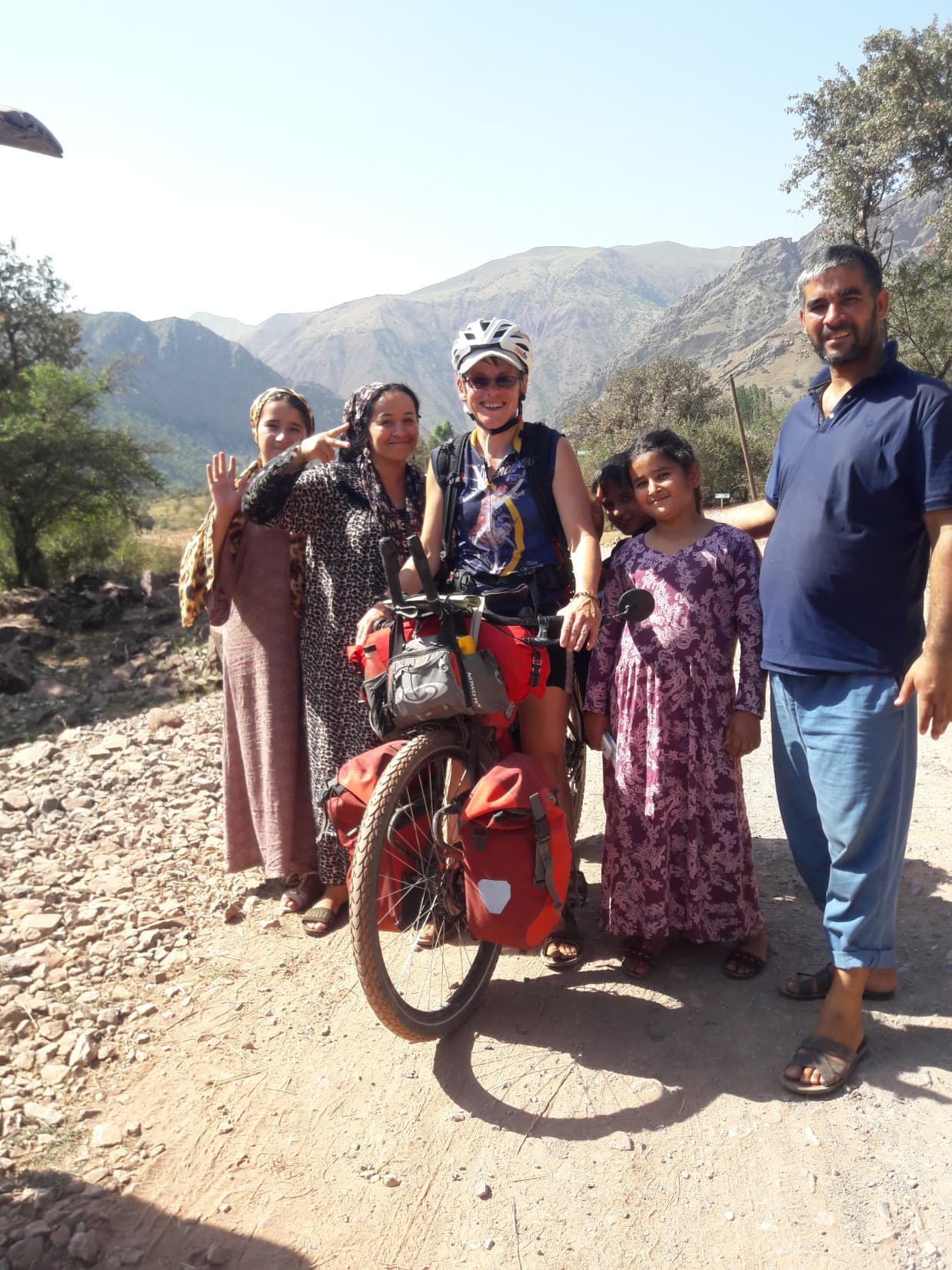
For me, it's the ideal mode of transportation. The perfect speed for exploring:the opportunity to chat, meet people (much than in a car), plus it's more fun and less polluting than car (even if the carbon footprint of a return flight is far from to be negligible).
Who do you think cycling is for?
For everyone! You can ride 100 km a day (often it can be complicated with a loaded bike on the bad and uneven tracks of Central Asia 😉 ) and camp in the middle of nowhere. You can also ride 20 km a day and sleep in homestays or with the locals. Everyone travels according to his desires and capabilities.
Why do you travel alone?
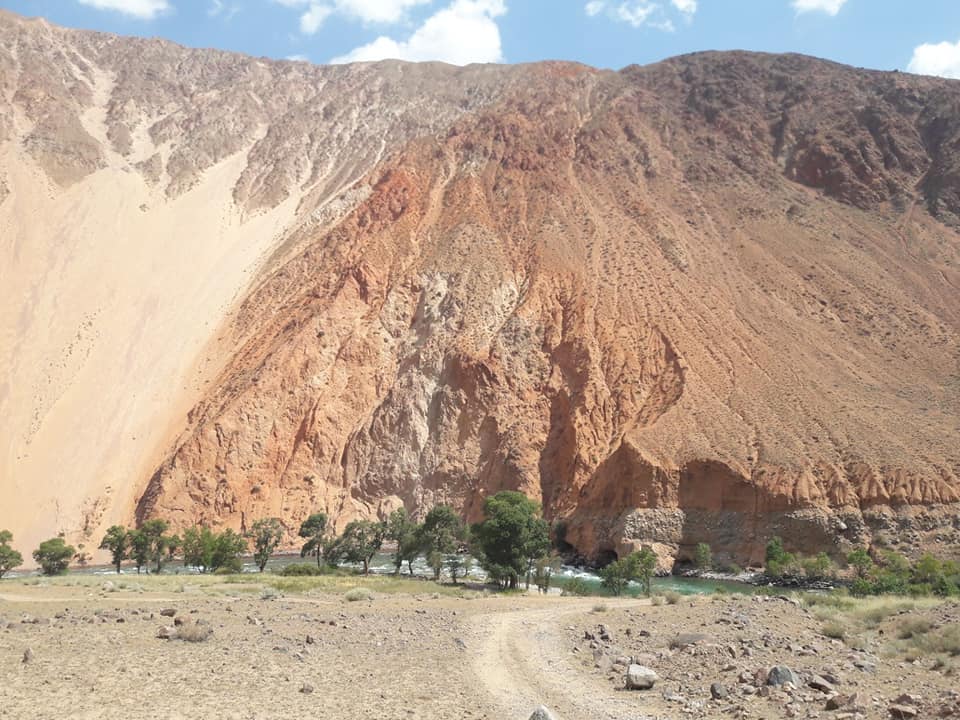
I love traveling alone. For me, it's absolute freedom—you go where you you want, you stop when you want: you eat what you want. I I'm happy to exchange a few words or even share a few miles with other cyclists when I meet them, but it doesn't go any further than that. I like camping alone in nature, I like riding alone, I never suffer from loneliness.
Maybe one day I'll be able to get my husband to join me, but I know it will be a different journey. And that I will still be continuing on my own.
Why did you choose Kyrgyzstan to travel by bike?
For several reasons, but above all the Silk Road and the Pamir Highway, which are classics for cyclists . After suffering quite a bit from the cold last year in Iceland, I I was looking for a slightly less icy destination. I brought back some very pretty blue frostbite from there 😀 )
Where have you travelled before?
Especially in Scotland, Iceland, England, France and, of course, Italy.
How is Kyrgyzstan different?
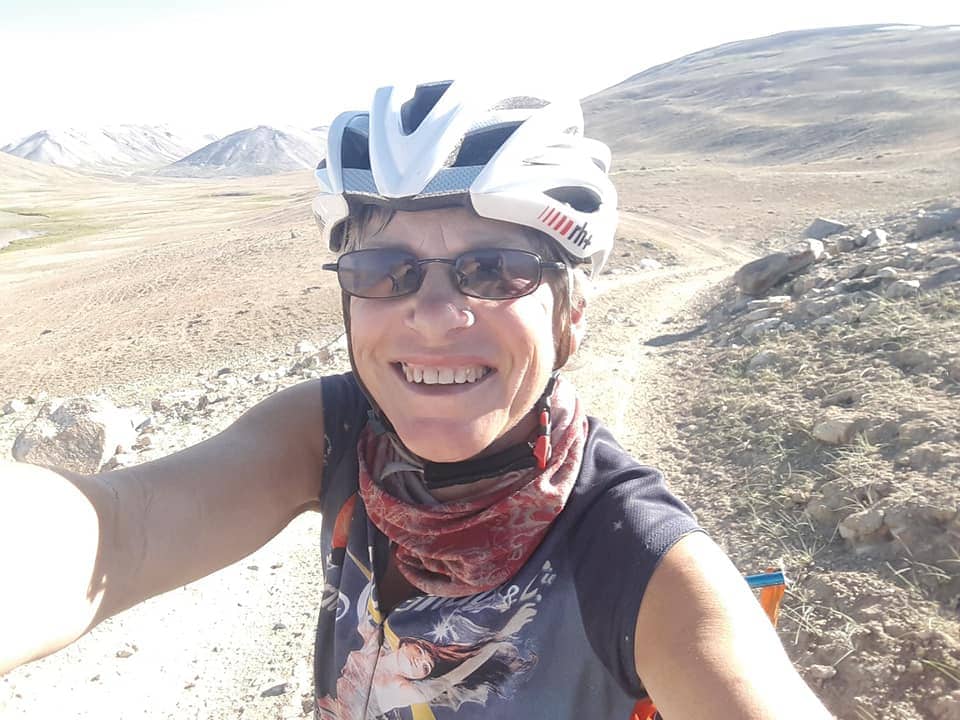
I had never really left Europe on a bike (even though I had done triathlons in the USA). , Central Asia is really another world. There is a lot of difference in altitude (even if in Iceland and Scotland you also climb a lot), you have to deal with the altitude, the change of food, the language.
Have you had any specific training?
Not at all. I cycle a lot all year round (9500 km on my bike last year, during trips, but also for daily commuting as well as for pleasure) , I am undertaking specific training all year round 😀
What insurance?
I had checked with my agency, thinking they would make me take out special insurance. But in fact, I was covered by the family car insurance (Mondial Assistance) for stays of less than three months. That said, looking back, I was only covered only myself and not in transportation. In hindsight, it was perhaps a bit tight: if I had had to repatriate the bike, it wouldn't have been covered.
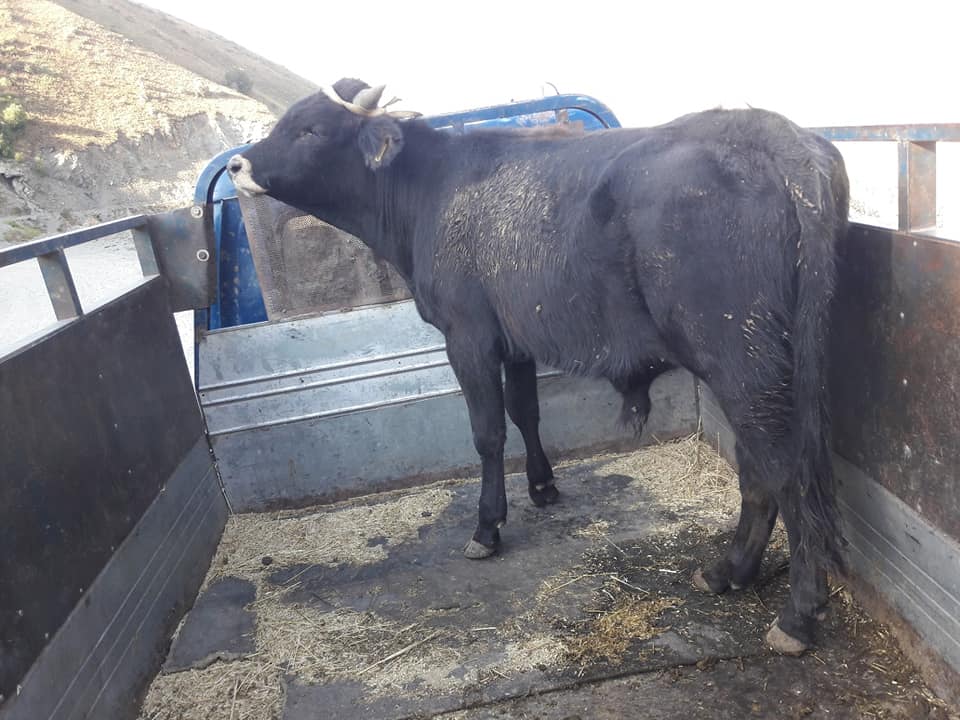
One day, suffering from a strong dose of tourista, I accepted to take a lift with a truck. So I travelled 90 km with a calf on the plateau of a cattle truck... without been covered by insurance.
I recommend this article, by Georges-Michel, which explains the coverage offered by bank card insurance.
Did you have any vaccinations before you left?
I had done all the recommended vaccines except hepatitis B (I hadn't time in the vaccination calendar, I'll do it next time).
So, mandatory vaccines in France: MMR, DT polio (booster) plus rabies, typhoid, hepatitis A.
What documents did you have with you?
Passport, vaccination card, I had also taken passport photos in advance for the border permits (which finally, due to lack of time, I didn't ask for) and two copies of my passport (in Tajikistan I was asked for one, which I had to leave behind during a check. 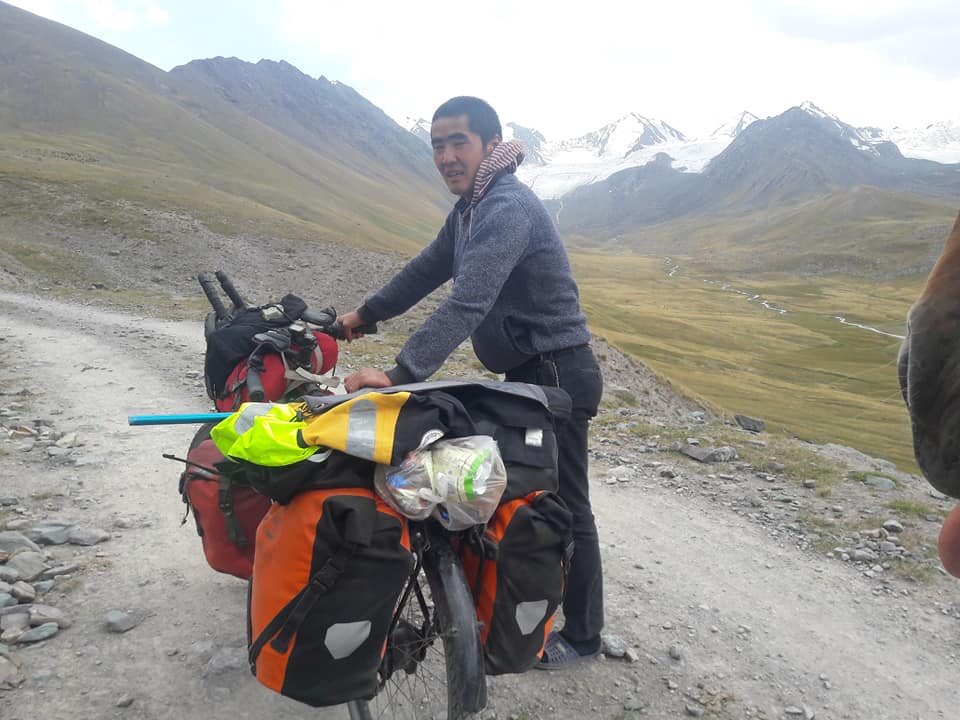
What maps do you use to find your way around Kyrgyzstan?
So that's a bit of a downside. I had the Gizi map on paper , but it was only useful for getting an overview and major routes. The scale is much too large, there is no detail, some trails are marked can't be found, others that aren't on the map...
Finally, OpenStreetMap (participatory digital mapping) was the most useful to me. I use the Locus Map app which allows me to make my tracks, to import them (very practical!) and which manages the difference in altitude (I can graphically visualize the routes, which is very useful when cycling!) Therefore it was mainly via my telephone that I travelled, even though I always took a look at the paper map to get an overall view.
What kind of equipment did you bring on this trip?
Multi-purpose clothing (it can be cold at high altitudes and very hot on the plains). I also had waterproof clothes, you can do without them... even if we are happy to have them when it starts to rain.
A good tent, a good sleeping bag, something to filter water (even though I only filtered water from rivers, not spring water or water from wells or from pumps in villages), is nothing special... except that you have to carry everything, striking a balance between sturdiness and lightness.
For the stove I had opted for a petrol stove (you can find them anywhere) but I also had a mini gas stove (70g) as a backup. The petrol smelling bottle of fuel does not necessarily pass easily at the airport. Cooking with gas during the last week allowed the smell to evaporate.
Which bike did you use for this trip (type of bike, development, wheels, tyres)?
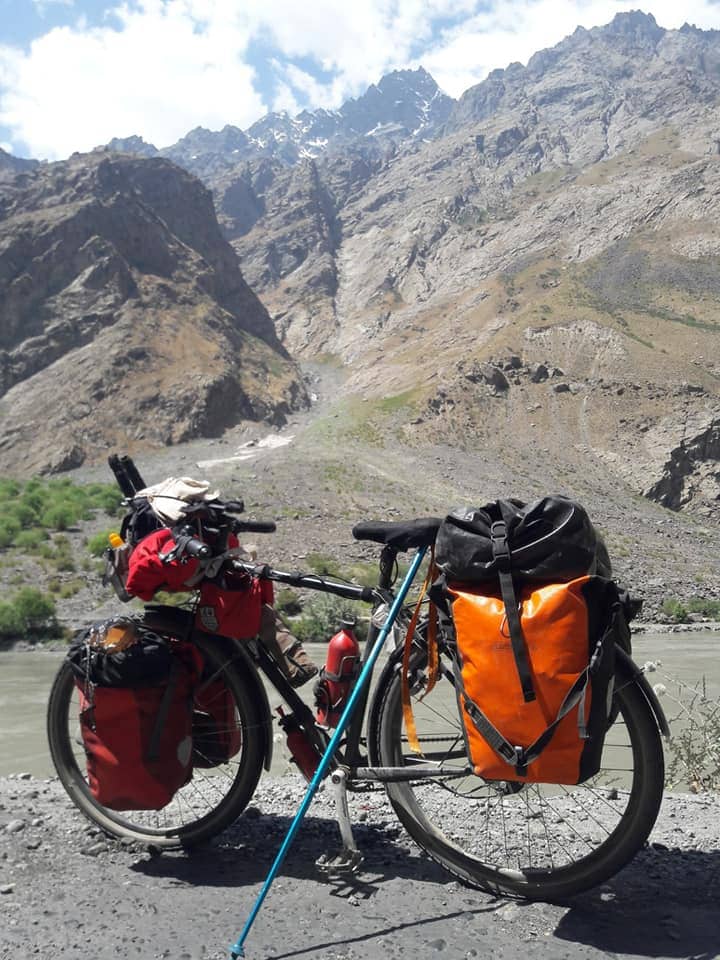
For the first time, I had a real touring bike that I had just bought for myself (made by François Coponet of Cycles Itinérances (http://cycles-itinerances.fr/), a frame builder who lives in Mousson in eastern France) with 27.5-inch wheels.
But before that, I used to ride my old 26-inch mountain bike. Plan for mountain bike gearing with a loaded bike. In any case, there are a lot of climbs, and the roads are mostly difficult trails.
Choose reinforced tires! The roadsides are littered with pieces of vodka bottles thrown from cars 🙁 For me, itchose Schwalbe Marathon Mondial tires. I only had one flat tire (a very thin piece of cable very thin wire that managed to pierce the tire).
I had cable disc brakes and a Rollhoff hub, which were very comfortable for this type of trip (you can change gears while when stationary), but before that I rode with hydraulic brakes and conventional derailleurs.
I saw on your pictures that you don't have automatic pedals: why?
Because it's not versatile enough. With trail shoes, I can ride and walk comfortably. Sometimes you have to push your bike for a long time. You can also choose to put it down and go walk in the mountains. I had a pair of sandals for crossing fords (and to air my feet when it was very hot) and a pair of trail shoes, which covered all situations.
What accessories did you have on your bike?
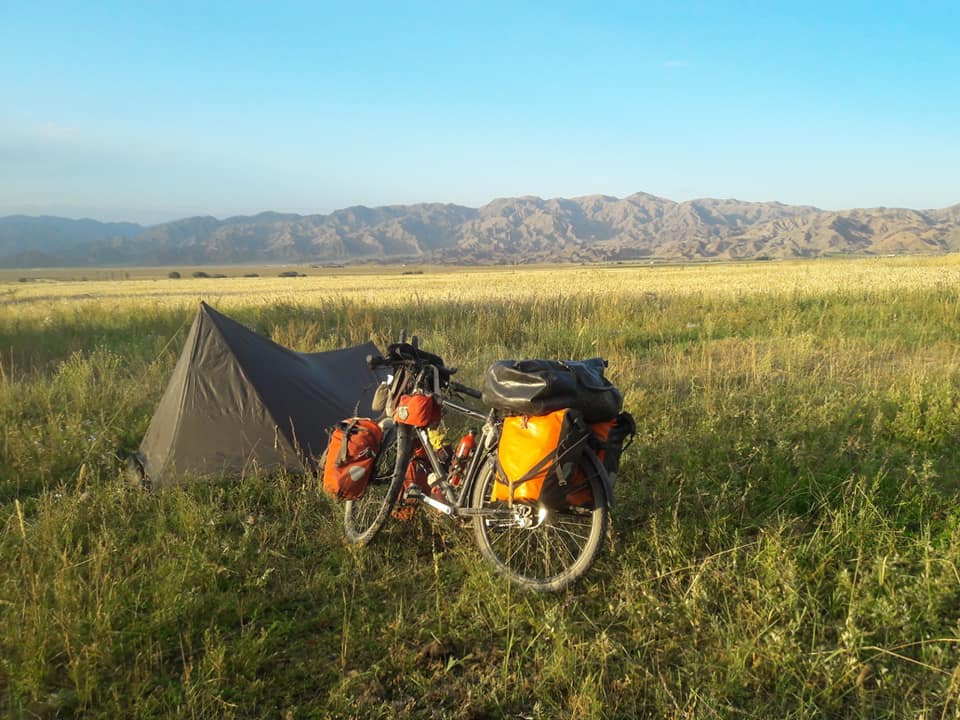
A hiking stick with a colored ribbon tied across the rear panniers to keep cars away! (It also serves as a kickstand by locking the brakes with Velcro).
Driving in Kyrgyzstan is pretty awful. They have no idea of safe distances for passing a bicycle (they are much more comfortable overtaking horses). Keeping vehicles a little is also a matter of safety...
A mirror is great too, unfortunately I had broken mine at the start of the trip. The bell was only ever used to amuse the kids.
I also had a hub dynamo so I could recharge my phone, my e-reader, my anti-virus UV filter, and my electric lamps (I recharge using the very reliable USB2BYK manufactured by a small French company ( http://www.eurecart.fr/ ).
That said, in Iceland the hub dynamo provided most of the electrical production (one phone charge per day) and the solar panel was anecdotal. Whereas in Kyrgyzstan the very present sun was almost entirely sufficient to recharge everything.
How did you maintain your bike?
I didn't do anything in particular.
Clean and oil the chain from time to time, adjust the brakes when the cables relax. Adapting tyre pressure to the track (deflate a bit when the track is really bad in order to cushion )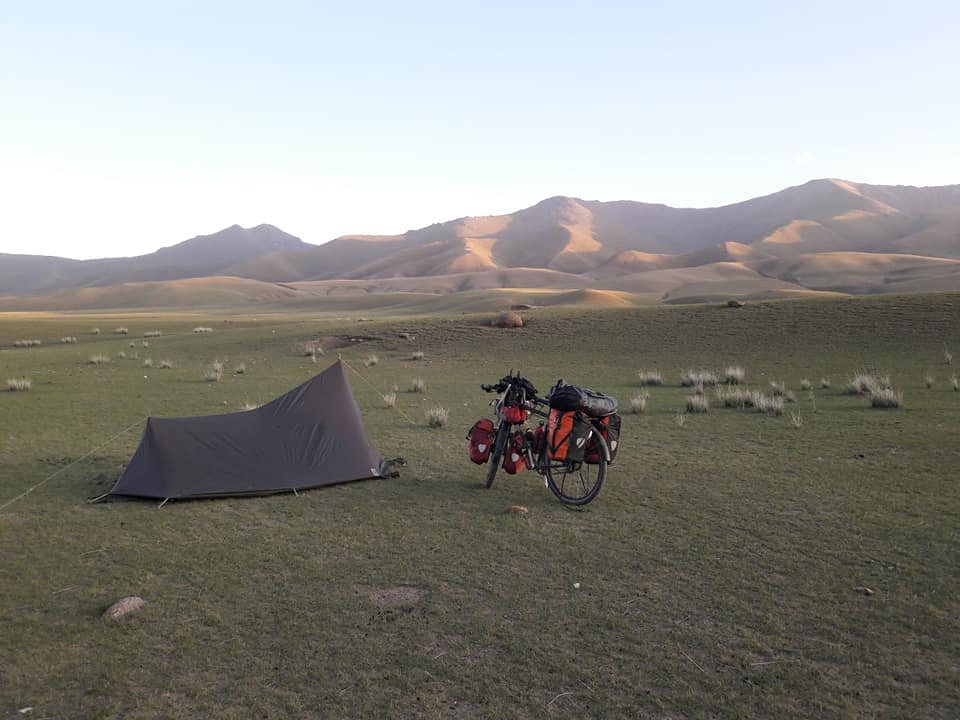
What equipment did you take with you to maintain and repair your bike during your trip?
I really like to be independent and to be able to repair as many things as possible myself. So I have quite a large tool kit.
- Pump with pressure gauge
- Puncture repair material (dissolve, patch, scraper)
- Small clamp
- Very complete multi-tool with chain drift, torx spanner, all spanners
- Allen key, screwdriver, pedal lifter, various spanners, spoke wrench....
- Spare spokes for two-wheelers
- 1 spare tire (since Iceland, where I blew out 3 rear tires , I'm a little traumatized when it comes to tires)
- Brake cables x2
- Derailleur cables x2
- Spare pads x3 pairs (one spare + one spare)
- Rilsans
- Twine
- Two small pieces of road tyres that can be used as a patch if the tyre tears (some people sew the tyres back on, one day I'll have to try).
- Spare meter battery
- A few pieces of wire and heat-shrink tubing (in case I rip the wire off the dynamo hub)
- Some chain links.
- 3 very strong tyre changers (one steel, two aluminium)
- Replacement screws for luggage racks and panniers
- Very strong black tape (useful for everything... repairing the tent, the panniers, saddle, and even the bike itself).
- An inner tube
- Vaseline oil (but cooking oil is fine)
- (When I was mountain biking, I also had some brake fluid, a derailleur hanger, and a small tool to be able to remove the cassette).
What do you recommend checking on a bike each day before setting off?
In Iceland, I checked several times a day that the tyres were not torn, but in Kyrgyzstan I was much cooler. The screws on the panniers like to take their independence... every 3 or 4 days, it's really useful to check that they haven't (I did lose two pannier screws though).
Remember to clean and grease the chain from time to time, as dust is omnipresent, it likes to stick to the links.
Any other accessories?
A basin for washing (be careful to dispose of the soapy water away from rivers, soap is perfectly biodegradable but not in the water! Discharged directly into rivers without being filtered by the soil, is deadly for aquatic organisms.
Olive oil for cooking (grocery shops don't offer much choice and you quickly get fed up of Chinese noodles. Olive oil helps in a great way to properly cook peppers, onions, courgettes, apples lentils over the long term, it saves your appetite); mosquito repellent (to survive Lake Issyk-Kul!)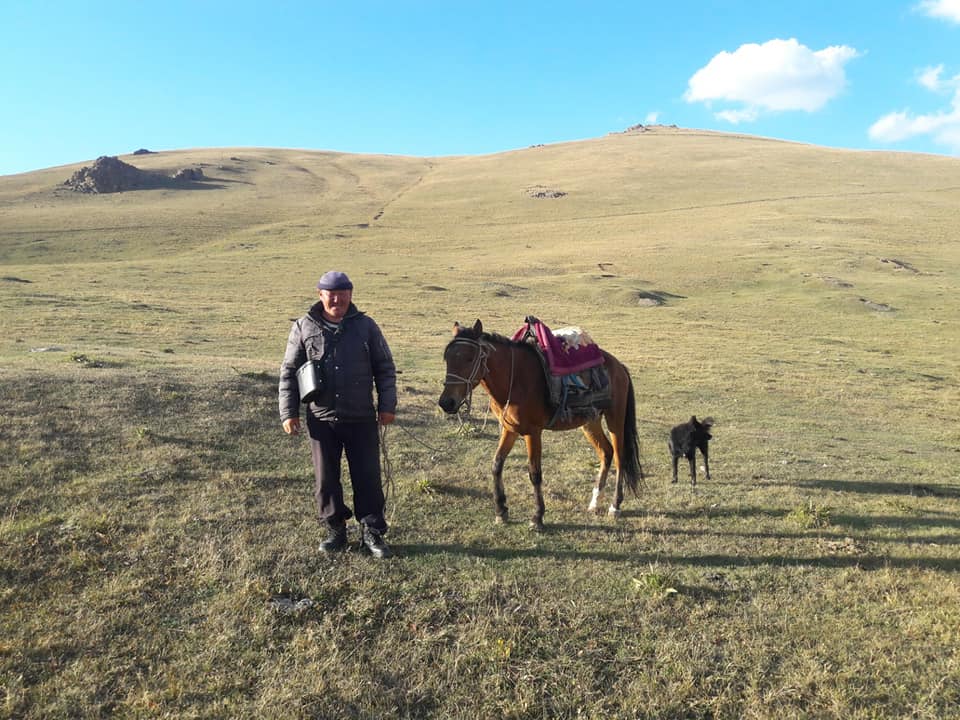
What was your itinerary in Kyrgyzstan?
Completely by chance. I arrived in Sary Tash (from Pamir) with the idea of going to Sary Moghul and then to Osh to get a border permit so be able to go to the regions near China, and in the end I didn't did any of that.
I traveled almost day by day, looking at the map. The only real road I followed without having any other choice was the one between Jalalabad and Naryn. I left it to go up to Song-Kul ... after that I had no idea where to go.
In fact, it's quite complicated to plan. Some trails are so bad that you have to push your bike up the hills the whole time, and needless to say, you can't make up time on the descent: I've gone down passes without ever exceeding 5 miles per hour. One day, I "rode" all day to cover 19 miles with mud up to my hubs.
I have also followed the Silk Road Mountain Race route on several occasions. It was magnificent; thesecertain paths are much faster than some roads (the Kazarman road is a nightmare in some places on a bike— pebbles, corrugated metal, etc.) and I planned my routes to avoid the "highways" as much as possible (the expressway between Balykchy and Bishkek) which I ended up staying on because there wasn't much and it was quite pleasant to ride.
I didn't want to do EVERYTHING over a given time, I hate bucket lists. I prefer to go where I want, to enjoy a place I like, to leave another one that I only half like without having finished visiting.
Of course I missed a lot of stuff, but I took the time to go to the remote places that I adored. When I left I saw some very beautiful and tempting mountains... no big deal, I'll be back 😀
What was your budget for this trip?
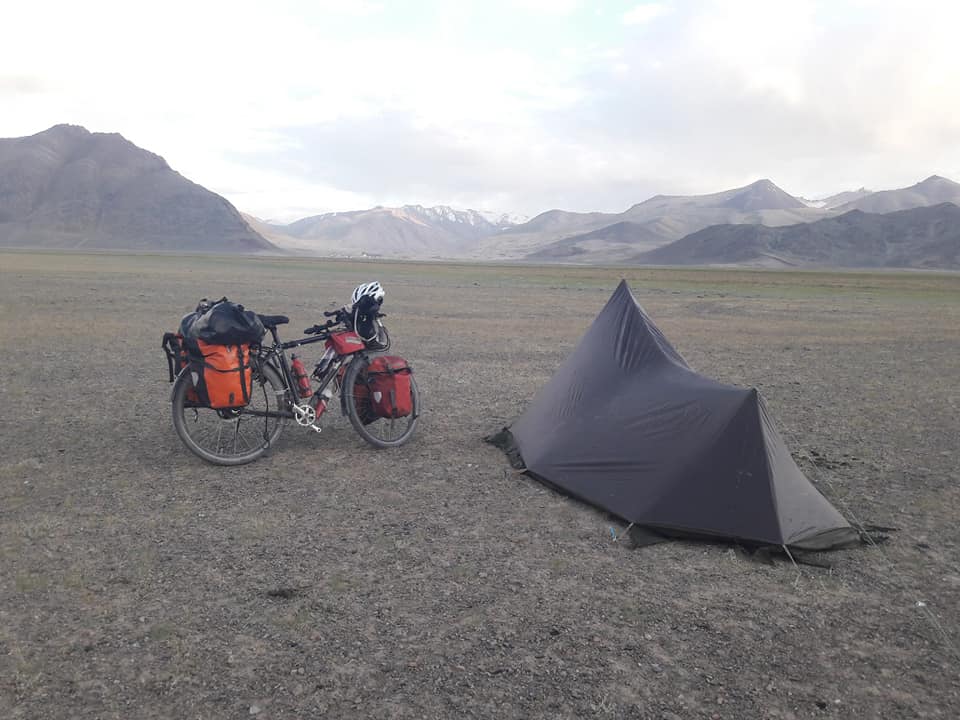
It depends a lot on each person, but everything there is very cheap for us. Except in Bishkek where I stayed at theTunduk Hotel (I recommend it: it was great!), I always slept in a tent for free. For food from time to time (when I could findit ) I ate in a restaurant at lunchtime (between 200 soms and 400 soms). Otherwise I shopped in grocery shops, in bazaars along the way.
The Kyrgyz people are very kind. I was offered tea along the way, given fruit and also nans. I was also invited to stay the night (I always declined, as I prefer to sleep far away from everything, in nature).
Do you think there are any particular risks associated with travelling in this part of the world?
I didn't find that there were any particular risks inherent to Central Asia. Well, it's true, I suffered quite a bit from traveler's diarrhea and once from food poisoning, but I wasn't taking many precautions. And apart from the food poisoning, it it didn't spoil my trip. I was glad I had been vaccinated to avoid the most serious problems (I just read that a traveler caught typhoid).
Of course, you can use Micropur tablets (if you can tolerate them, which not my case) or filter all the water (but you have to do it twice: once with a conventional filter and then with a UV filter for the viruses that conventional filters let through). But that takes time time, and I wasn't at all sure that my discomfort was caused by the water.Honestly, next time I'll do the same thing and too bad for the turista.
Traffic when you're a cyclist can be complicated. I have to admit that in the South, the M41 gave me cold sweats. In Bishkek I ended up limiting myself because it was so unpleasant to ride.
Otherwise, for me, the main problem was the dogs. They're not vicious at all, but they're never tied up. They have a reflex to chase bicycles. You MUST stop immediately and tell them to get away VERY FIRMLY if they're aggressive (most often they are adorable).
Normally that's enough. Once, I was annoyed at having to cross a farm, and the owner (whom they didn't obey her) threw stones at them to chase them away. So I kept two stones handy to do the same (don't aim at the dog, you aim in front of them), but in the end I never them.
I only had major problems on major roads, when we were going too fast to check everything at the side of the road or to stop suddenly. Sometimes you're driving along quietly and they appear out of nowhere. On the four-lane road from Balkhash to Bishkek, in the middle of downhill, I heard a huge bark behind me, I had a huge German Shepherd on my tail!
I yelled, "GET OUT OF THE WAY!!!!" and he stopped dead in his tracks. Phew! I couldn't see myself stopping or aiming at him with my rocks at 50 km/h.
Do you have any additional advice for readers?
It's very easy to hitchhike, even by bike. I never stuck out my thumb, and at every pass, every bout of bad weather, trucks and even cars would stop to offer me a ride. Taxis take bikes, and even marshrutkas offered me a ride! (Where do they put the bike? I don't , but since I saw a car go by with two live sheep live sheep tied to the roof, I no longer doubt their inventiveness 😀 )
Various travel guides I have read strongly emphasize that women must wear a veil in villages and not wear shorts. I wonder if we have traveled in the same country... Many Kyrgyz women are not veiled, and I have seen young girls wearing shorts in some villages. For me, it was bare arms and legs on my bike throughout the trip (when it was hot) and I never felt the slightest discomfort. It was more in the city, when I , since I was a tourist and not on the road as a cyclist.
And I almost forgot, the most important thing to prepare the trip is to read the complete guide to travel in Kyrgyzstan by Georges-Michel.
Thanks Marie, for this great interview. It's really nice. I wish you many new cycling adventures and I can't wait to follow them! I invite you to follow Marie on her blog of tricks for your bike.
Feel free to share your questions or your own experience in the comments.
Hello,
I would like to go on a cycling tour in Kyrgyzstan with some friends. Is it possible to have a phone conversation with you?
Thank you in advance.
Hi, I'll put you in touch with her